The Final Frontier of Drug Delivery: Navigating the Blood-Brain Barrier
By Pranav Seshadri and Corey McCann
Biology must meet the bottom line: here, we share our perspectives on advancing BBB-permeant discovery while aligning with the rigorous milestones of modern biotech venture capital.
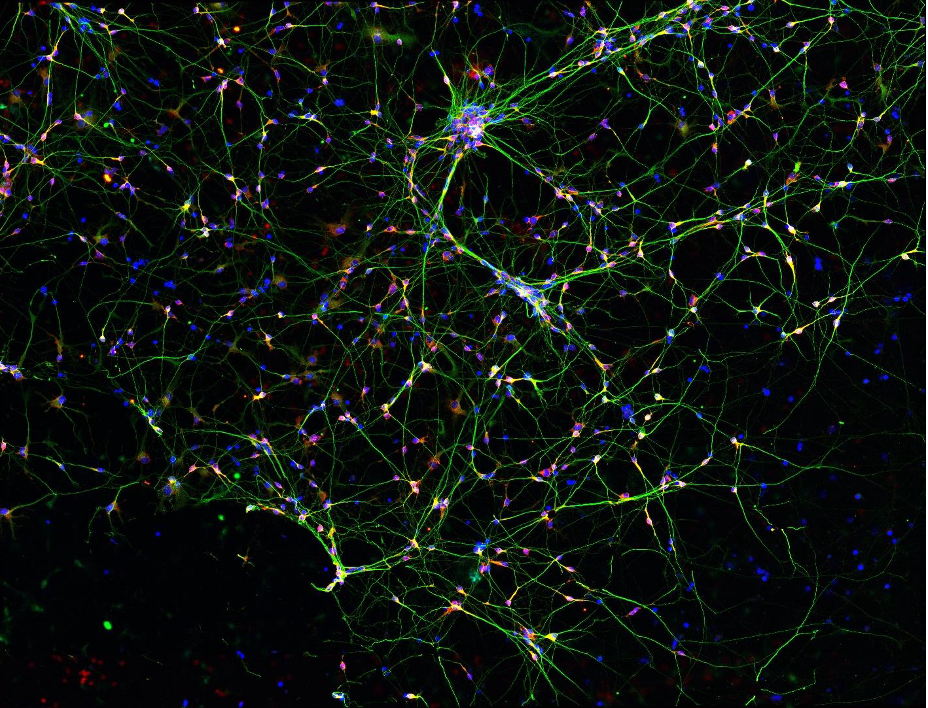
“Cafe Neuro: Visualization of Forebrain Neurons” (2024), Zia Barnard. Courtesy of the MIT Koch Institute for Integrative Cancer Research
Chapters
The Blood-Brain Barrier as a Financial Filter
Why the Barrier Holds
Receptor-Mediated Transcytosis: The Learning Curve
Where Are We Today?
Proof of Delivery. Question of Medicine.
T.Rx’s Perspective
Conclusion: The End of the Beginning
The Blood-Brain Barrier as a Financial Filter
In oncology, a potent molecule is a potential drug. In neurology, a potent molecule is a highly specialized and expensive toxin, until it proves it can navigate the most restrictive border crossing in the human body.
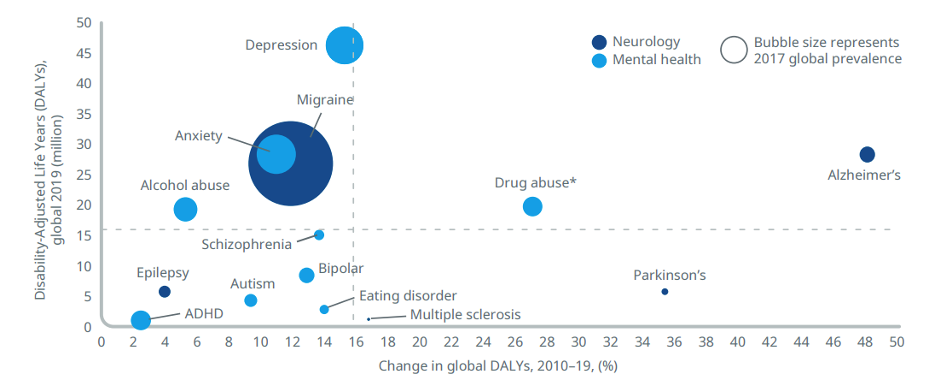
Over the last two decades, we have entered a golden age of biological understanding of the Central Nervous System (CNS). Thanks to comprehensive genomic maps and high-confidence validation of promising targets like LRRK2, TREM2, and alpha-synuclein, our view of the brain's inner workings has never been clearer. In almost any other area of medicine (oncology, immunology, or rare disease) this level of understanding would have sparked a wave of clinical breakthroughs. Yet in neurodegeneration, we are still struggling to breach the front door. The result is a striking disconnect: a wealth of validated genomic leads, and a sobering shortage of clinical results to show for them. For a rapidly growing patient population, the promised revolution in CNS therapies remains perpetually "just around the corner," held back by a delivery problem we have yet to solve.
Figure 1. The global disease burden of CNS is high and growing fast (IQVIA)1
The industry is caught in a widening gap between our ability to identify and validate targets and our ability to reach them. We are getting pretty good at identifying the lock, but we still struggle to forge a key that can survive the journey.
We think of the blood-brain barrier (BBB) as more than a biological membrane. We argue that the BBB is also a financial filter. Because the failure rate for CNS assets is so high, many investors price in both biological risk and a "delivery tax."2 A molecule can have excellent potency on the lab bench, but if its Kp,uu,brain (the unbound brain-to-plasma ratio, a measure of BBB permeability and transport) is negligible, the net present value is zero. Amidst the current cautious biotech environment, strong science alone is not enough. Platforms that might get across are a tough sell to investors. Instead, many prioritize assets that have already proven they can achieve therapeutic concentrations without triggering dose-limiting side effects in the rest of the body. Or, they move to other therapeutic areas with a perceived higher probability of success. The BBB is a primary source of uncompensated risk in a biotech portfolio—the reason a promising lead in a Series A pitch deck often looks more like a liability than an asset.
To understand where we are headed, we must reflect on where we spent decades failing. At T.Rx, we treat the BBB as a primary engineering and investment milestone. In the sections that follow, we explore the history of BBB penetration, recent data from industry leaders, and whether current technologies truly clear the bar or whether the industry is simply getting better at celebrating small wins.
Why the Barrier Holds
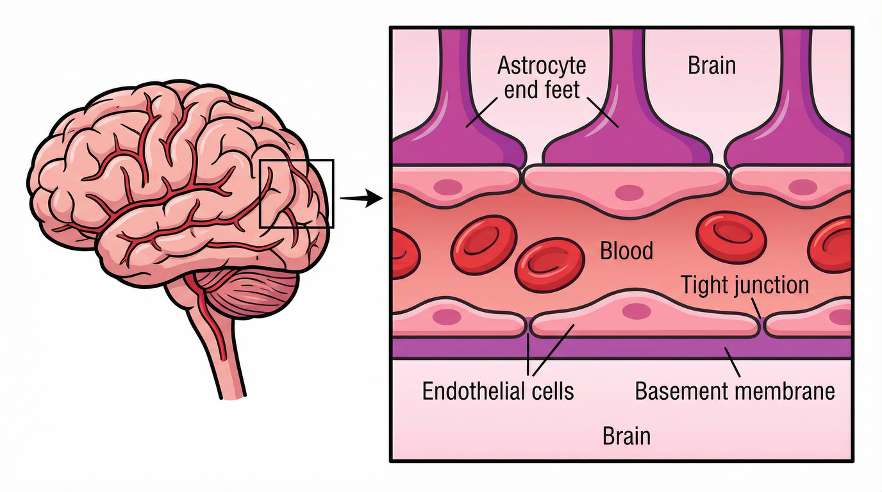
To understand why delivering drugs to the brain is so difficult, it helps to appreciate that the BBB is far more than a simple layer of plastic wrap around the brain. It is a dynamic, multi-layered interface: a neurovascular unit made up of endothelial cells, pericytes, and astrocyte end-feet.3 Its biological purpose is remarkably elegant. It maintains the brain's delicate internal balance by tightly controlling which nutrients flow in and which waste products flow out.
Figure 2. A schematic diagram of the blood-brain barrier, adapted from Alahmari et al. (2021)4
From an evolutionary standpoint, the BBB is a masterpiece of security. The endothelial cells lining the brain's tiny blood vessels are sealed together by tight junctions (proteins called claudins and occludins), which eliminate the small gaps (fenestrae) found in blood vessels throughout most of the body. This creates a continuous cellular wall that forces any molecule entering the brain to pass through the cells themselves, rather than slipping between them.
What does this mean for therapeutics vying for access to the brain?
● Size Constraints: Over 98% of small molecule drugs fail to penetrate the BBB due to the stringent physicochemical requirements for passive diffusion.5 Generally, only small, lipid-soluble molecules with molecular weights of <400-500 Da are able to permeate the membrane. While large molecules (biologics, antibodies) can access the CNS, they do so with very low efficiencies that are generally pharmacologically insufficient for most targets.
● Metabolic Considerations: The barrier is packed with enzymes (e.g., cytochrome P450, peptidases, esterases) within the endothelial cells, further restricting the transfer or retention of compounds across the BBB.6 These enzymes can metabolize, degrade, or deactivate foreign substances before they reach the brain parenchyma.
● Efflux Liability: There are many energy-dependent efflux transporters in the BBB, functioning as “clearance systems” for metabolites and catabolites produced in the brain.6 Even if a molecule manages to diffuse across the membrane, efflux pumps quickly recognize xenobiotics and eject them back out. P-glycoprotein (P-gp/MDR1) is the most clinically studied of these, and its overexpression has been linked to treatment-resistant epilepsy and CNS tumor resistance.7
The barrier’s whole job is to keep the outside world out (e.g., pathogens, toxins, inflammation) and it makes no exception for a therapeutic agent. And, it is directly responsible for the all-too-familiar story of strong lab data showing 100% target engagement in a petri dish and 0% in a living system.
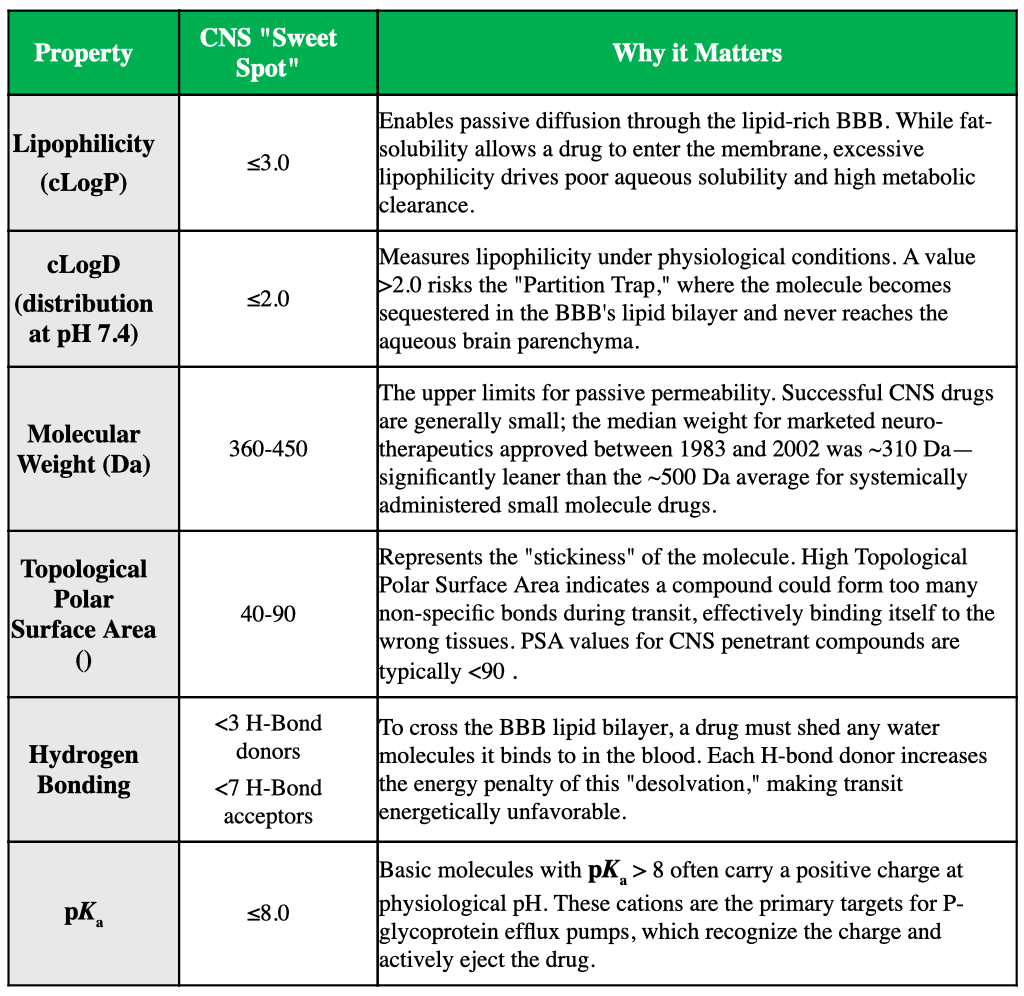
To give a molecule a fighting chance of getting through the door, there are a few rules of engagement that govern membrane permeability.
Table 1. “Goldilocks” parameters for enabling BBB permeability, based on Pfizer’s CNS multiparameter optimization. Adapted from Wager et al. (2010)8 and Rankovic et al. (2015)9
The CNS multiparameter optimization (MPO) score is less about perfection in any single category and more about the overall balance. A critical challenge in medicinal chemistry is the "SAR Seesaw": fixing a weakness in one property (such as increasing molecular weight to boost potency) often comes at the expense of others, like LogD or permeability.
How attractive a program is to investors depends on the intended clinical use. For acute indications (e.g., status epilepticus, ischemic stroke), a program needs rapid CNS penetration. Compounds that reach the brain quickly command a premium. For chronic neurodegeneration, the math shifts; lower-permeability compounds are acceptable if they compensate with high metabolic stability and low clearance, accumulating over time. In either case, permeability alone is insufficient. A molecule that clears the barrier but triggers efflux pump recognition solves the wrong problem, reaching the endothelium only to be escorted back out before touching target tissue. In certain disease states, the BBB itself is partially compromised: active MS lesions, glioblastoma, and acute TBI all involve measurable disruption of tight junction integrity, and there is emerging evidence that Alzheimer’s drives pericyte loss and endothelial dysfunction. For programs targeting these indications, the disease is doing some of the delivery work. This is a meaningful, but often underappreciated, variable when sizing up translational risk.
Consider two examples of drugs: one which certainly crosses the BBB but enjoys little clinical success, and one that excels in permeability on paper but fails to deliver in practice.
• Donepezil (Aricept): In the early 1980s, Eisai developed donepezil as a second-generation acetylcholinesterase inhibitor for Alzheimer’s, decades before the CNS MPO was formalized. Eisai essentially designed donepezil by intuition, prioritizing a lean molecular weight of ~379 Da, lipophilicity, and a polar surface area right around 40.10 Donepezil achieves strong brain exposure and inhibits acetylcholinesterase exactly as designed. Yet, despite favorable pharmacokinetics, donepezil is not considered a successful treatment for Alzheimer’s given its modest clinical benefit. The takeaway is simple: getting through the BBB is necessary, but not sufficient by itself.
• Loperamide (Imodium): Loperamide is an opioid agonist with high μ-receptor affinity, reasonable lipophilicity, and a molecular weight of ~477 Da.11 On paper, loperamide is a prototypical CNS drug. In practice, P-gp transporters expel it from the brain so efficiently that it acts exclusively in the gut, allowing for its use as an over-the-counter antidiarrheal. At very high, off-label doses, loperamide crosses the BBB and produces opiate-like CNS effects. This is exactly how loperamide abuse emerged and why the FDA eventually capped single-dose packaging.12 Loperamide’s physicochemical profile demonstrates that the BBB is a layered system. A molecule that clears one layer may still fail at the next.
The more profound consequence of BBB selectivity is that entire target classes can be rendered effectively undruggable. Intracellular aggregated proteins like tau and alpha-synuclein are not effectively reached by biologics and are resistant to small molecules. Neuroinflammatory cytokines like TNF and IL-6 are well-validated targets elsewhere in medicine yet are largely insulated from those same therapies once inside the brain. The BBB filters out disease axes as inaccessible to certain modalities.
The MPO framework describes what it takes for a small molecule to get across. For decades, though, the field largely skipped that discipline and relied on the blunter strategy of making molecules sufficiently fat-soluble to cross the barrier. Plenty of those compounds did cross the BBB, but didn't do anything once inside. They were molecular tourists, trapped in the brain's lipid membranes and never reaching the water-soluble receptors they were built to engage. Balancing potency against permeability with small molecules alone proved difficult, and the field started looking for ways around the membrane entirely.
Receptor-Mediated Transcytosis: The Learning Curve
While the MPO framework clearly defines the constraints for small molecules, it provides no clean roadmap for biologics. For large molecules, the challenge extends beyond chemistry into biology itself, requiring a fundamentally different strategy that exploits the BBB’s own transport machinery. Without a delivery mechanism, developers are forced to compensate with dose, raising COGS for expensive biologics and narrowing the therapeutic window as systemic exposure climbs before CNS levels become meaningful.
When it became clear that passive diffusion had its limits, the field pivoted toward active transport. The goal shifted from picking the lock to hijacking the brain's own nutrient supply chain through receptor-mediated transcytosis (RMT). On paper, RMT makes a lot of sense as it uses the brain's built-in receptor systems to shuttle cargo across the BBB in a targeted manner. This approach opened the door to a much broader class of therapeutic agents for the CNS, enabling large, non-fat-soluble biologics (e.g., gene therapies, monoclonal antibodies) to cross from the bloodstream into the brain tissue.
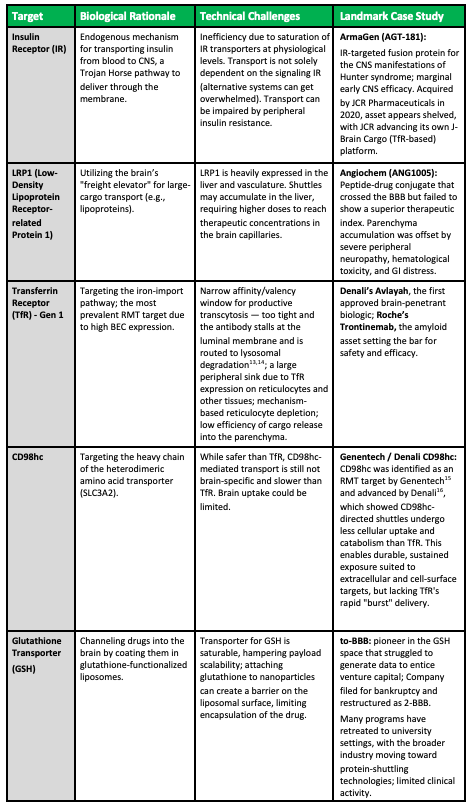
While the concept was sound, early RMT programs suffered from poor engineering. The field systematically learned, through a series of high-profile setbacks, that productive transcytosis is sensitive to three variables: how tightly you bind, how efficiently the receptor traffics, and whether the cargo releases on the other side. The programs below represent that learning curve, with each one contributing a design principle that the next generation built on.
Table 2. Active Transport Targets for BBB Penetration
The collective history of these platforms reinforces that delivering a drug across the BBB via active transport involves more than moving a molecule through the endothelium. We think of it as a three-act play (Binding, Transcytosis, and Release) where failure at any stage renders the program clinically inert. But the acts are not equally challenging. Decades of work have largely solved for binding. Nowadays, programs live or die in the second and third. For the investor, the three acts are a de-risking map; the second and third acts may gate valuation and subsequent funding tranches.
● Act 1 – Binding & Saturation
Early programs learned that binding is necessary but decoupled from delivery. A shuttle can both achieve full receptor occupancy and deposit nothing in the parenchyma. The consequential design choices are therefore not whether you can bind, but how you bind, because affinity, valency, and epitope set up everything that happens in Acts 2 and 3. Binding a ubiquitous nutrient receptor carries costs around systemic safety. TfR1 is expressed on erythroid precursors, and high-affinity anti-TfR1 antibodies, particularly those retaining active immune effector function, have driven reticulocyte depletion and immune-mediated liabilities in non-human primates.17 Combined with the rapid peripheral clearance of high-affinity TfR1 binders, these peripheral effects are best treated as their own axis of risk.
● Act 2 – Transcytosis
Transcytosis is where the delivery problem gets uglier. Receptors might otherwise recycle cargo to the luminal surface or divert it to the lysosome. Here, however, the receptor must carry its cargo through the endothelial cell. This is a technical challenge, sensitive to how the shuttle binds. Foundational TfR work showed that excessive affinity or avidity is inefficient for trafficking, with antibodies and receptors being routed into the brain endothelial cell lysosome and degraded. Higher binding strength paradoxically lowers net brain delivery.13,14 As such, productive transcytosis requires tuning affinity and valency into a narrow window.
The insulin receptor illustrates the opposite failure: a receptor can bind beautifully and still be a poor transporter. William Pardridge's group at UCLA spent years on the HIRMAb platform, a chimeric anti-insulin-receptor antibody engineered to ferry cargo across the endothelium.18 ArmaGen advanced it into the clinic for Hunter syndrome, fusing the HIRMAb to a therapeutic enzyme, but results were marginal: the insulin receptor is not primarily in the business of transcytosis, and engaging it at all risks perturbing metabolic signaling.
Different receptors sit at different points onthis spectrum, and the art is matching the shuttle to the pathway's intrinsic transport behavior. CD98hc, for example, loads more slowly than TfR but accumulates with less lysosomal uptake and catabolism. It trades TfR's rapid burst for durable exposure. No target is perfect. One must instead balance a receptor’s transcytosis efficiency and the risks that come with binding it.
● Act 3 – Release
Now, the cargo must dissociate from its receptor and distribute to the cells that need it. Here, the very affinity that helped elsewhere becomes a liability. Bind too tightly and the shuttle never lets go on the brain side; the defining insight of the modern TfR era was that moderate, often pH-dependent, affinity balances engagement at the BBB against release once inside. Release, moreover, is only the first hurdle of this act. The brain extracellular space is a crowded, tortuous environment that impedes the passage of large therapeutics. Uptake into brain cells goes both ways: indispensable when the target is intracellular (oligonucleotides, lysosomal enzymes), but a source of loss when it drives catabolism before the drug reaches its site of action.
The RNA field hit the same release problem from a different direction. Lipid nanoparticles aren't RMT shuttles, but they make the point well. The very LNPs that escape the endosome cleanly and silence genes in the liver can reach rodent brain tissue and still barely knock anything down. Fewer than two percent of their contents typically escape the endosome, and neurons are far less forgiving of that inefficiency than hepatocytes.19 The field's answer was to stop trying to cross the barrier at all and deliver into the CSF directly. Nusinersen, the first approved ASO for spinal muscular atrophy, is dosed straight into the CSF. It’s a clinical success built on conceding that, for that modality, the BBB had won.
This history has pushed the industry away from fat-soluble small molecules and high-affinity antibodies toward modular transport vehicles engineered around the real constraints. The modern design brief is not "bind harder", but to tune affinity, valency, and epitope so the receptor actually traffics cargo across in Act 2, and to build in weak or pH-dependent release so the drug dissociates, distributes through the brain, and reaches its target cell in Act 3. Binding was the easy part; the platforms that win are the ones engineered for what happens after.
Where Are We Today?
Given the history of clinical disappointments, the biotech investor's key question is clear: "Can you prove it translates to humans?" Historically, the industry relied on immortalized cell lines that were notoriously poor stand-ins for human physiology. Today, the focus has moved toward high-fidelity, human-derived models that allow researchers to study BBB crossing in a controlled, predictive environment.
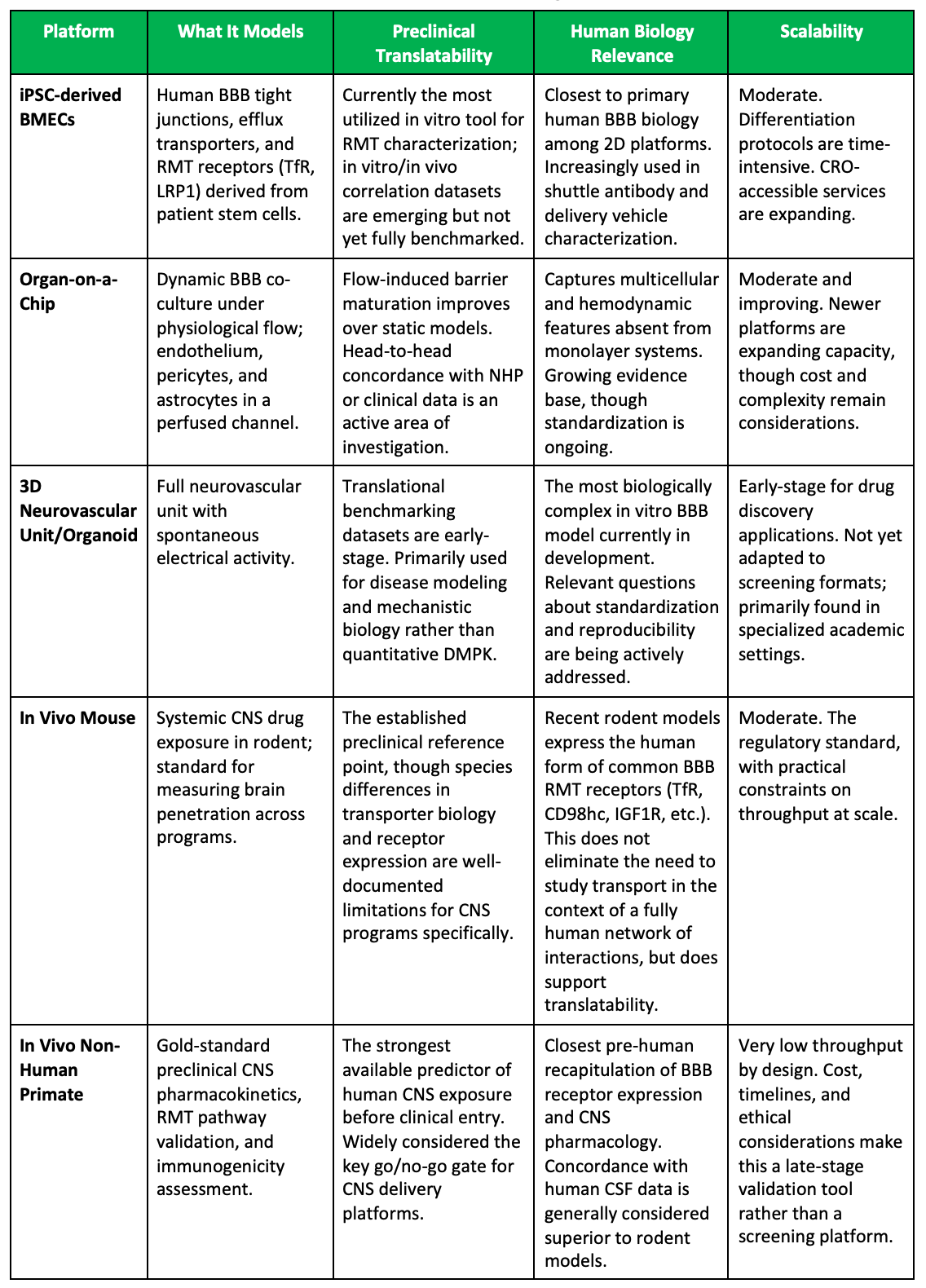
Promising recent approaches have moved beyond flat, two-dimensional cell layers toward complex three-dimensional organoid and organ-on-a-chip systems (Table 3). By combining iPSC-derived endothelial cells with pericytes and astrocytes, models like Alice Stanton's miBrain at Harvard recreate the hallmarks of living brains, including neuronal activity, functional connectivity, and multicellular interactions.20 Notable work in the field has enabled the development of biomimetic barriers, allowing researchers to analyze drug permeability across different compounds and doses with a level of detail that was previously impossible without major capital investment.
Table 3. Non-Exhaustive Review of Common BBB Modeling Methods
The move toward higher-fidelity models is as much an economic decision as a scientific one. Better human models raise the quality bar early, letting companies triage weak candidates faster and more cheaply before taking on the prohibitive cost of a non-human primate study. Their real value is as an early go/no-go gate: a candidate that fails in a well-built iPSC or organ-on-chip model is unlikely to survive in vivo.
The converse, however, does not hold. Confidence in the absolute predictive power of any in vitro system to recapitulate the full physiology of the BBB remains low, and the discovery of new receptors, the optimization of shuttles against them, and the evaluation of CNS-penetrant biologics all remain an in-vivo-heavy lift. These new models compress the front end of the funnel, improving the odds that what enters primate studies is worth the spend. Still, non-human primates constitute the real translational gate.
Against this backdrop of improved biological understanding and better preclinical triage, a handful of companies have emerged as the standard-bearers of modern BBB penetration. Yet even among the leaders, a technical divide is forming between those doubling down on validated pathways and those betting that the next generation of therapies must move beyond them entirely.
Currently, the industry is dominated by a heavy reliance on a few targets (TfR, CD98) with market leaders engineering workarounds to the limitations of first-generation RMT:
● Denali Therapeutics: Transport Vehicles
The foundational research behind Denali’s platform demonstrated meaningful brain delivery in both mice and NHPs using a monovalent, low-affinity TfR1-binding Fc fragment engineered to release into the parenchyma. Recently, Denali validated its approach clinically in mucopolysaccharidosis type II (MPS II), showing 91% CSF heparan sulfate reduction sustained to week 104, and 76% NfL reduction at week 153, with FDA approval as well.21
MPS II is a favorable proof-of-concept disease because its CNS readouts (CSF heparan sulfate, serum NfL) are clean and quantitative. The severe, neuronopathic form Avlayah is designed to treat involves substantial neuronal GAG accumulation, so this is real parenchymal engagement, not just clearance of perivascular substrate.
● Roche: Brainshuttle / Trontinemab
Trontinemab fuses an anti-Aβ antibody (gantenerumab) to a TfR1-directed Brainshuttle module; in the Phase 1b/2a Brainshuttle AD study it produced ~107 centiloids of amyloid plaque removal after 28 weeks at 3.6 mg/kg, driving most patients below the amyloid-positivity threshold, with a low incidence of amyloid-related imaging abnormalities (ARIA). NHP work estimated a 4-18x increase in brain exposure over the unshuttled antibody.22 Two Phase III trials (TRONTIER 1 and 2) are now underway. For any newcomer in the amyloid space, and arguably for TfR shuttles broadly, trontinemab is now the bar to clear on both efficacy and safety.
● Aliada Therapeutics / AbbVie: MODEL Platform
Recent conference-level mouse amyloid model data have shown superior plaque decoration and modeled lower ARIA rates for ALIA-1758 versus unconjugated comparators, but additional detail is needed.23 ALIA-1758, now designated as ABBV-1758 (TfR-shuttled anti-3pE-Aβ), recently completed a Phase 1 in healthy volunteers in mid-2025. AbbVie initiated a Phase 1/2 study in patients with Alzheimer’s disease in May 2026, but no Phase 1 results have been publicly posted.
The $1.4B AbbVie acquisition is not itself evidence of strong preclinical data. AbbVie needed an Alzheimer’s pipeline asset following a prior Phase 2 discontinuation for ABBV-916 earlier in 2024; the premium pricing prioritized optionality.24 The differentiation thesis (lower IV dose, less ARIA, safer chronic dosing) is legitimate, but lands in a crowded CNS indication, where the bar is set at beating approved drugs – a step beyond proof-of-concept clearance. If Phase 1 is clean and Phase 2 shows amyloid reduction competitive with trontinemab at a meaningfully lower dose and with comparable or lower ARIA, then Aliada's platform may have real legs.
● Manifold Bio: mCode
Manifold's mCode platform uses high-throughput in vivo screening (>1000 candidates) to optimize shuttle antibodies. It increases the throughput of shuttle optimization, but it is not an unbiased screen for entirely novel RMT receptors — binders must already exist before they can be ranked in vivo.
While Manifold’s strategy is intriguing, they have not yet shared detailed methods showing that their brain readout distinguishes parenchymal drug from vascular or endosomal drug. While they are likely keeping the platform close to their chest, there is a field-wide principle: the standard methodology in BBB shuttling involves brain homogenization, and whole-brain homogenate is well understood to overestimate parenchymal uptake.25 This will be a critical differentiator for Manifold.
● Stealth BBB Startup
One emerging stealth-stage startup has looked beyond the TfR1 axis, focusing on a NHP-native high-throughput screening platform to evaluate tens of thousands of shuttle variants per primate across many brain regions and peripheral organs. Their approach directly counters the species-translation gap that has historically undermined murine shuttle discovery programs. The company explicitly prioritizes high CNS-to-periphery expression ratios, with early platform data identifying shuttles with improved deep brain exposure relative to published TfR1 benchmarks. This company is a bet on the proposition that the delivery ceiling is simply a consequence of which receptors the field has chosen to chase.
The heavy reliance on "classical" first-wave targets, while technically validated, is beginning to show structural limits. These are essential nutrient pathways: their transport capacity is finite, their peripheral expression creates competing sinks and mechanism-based toxicities, and counterintuitively, they are hard to saturate at clinically meaningful doses precisely because the peripheral compartment absorbs so much of the dose.
TfR1-oligonucleotide conjugates now deliver robust, durable knockdown from a single systemic dose in non-human primates, and several are in the clinic. For knockdown-driven modalities, this pathway works. But the same primate data reveal why it also has a ceiling: past a threshold, more dose buys no more brain, because exposure plateaus. Layer on the peripheral sink, and the constraint becomes a property of the pathway. Where a near-maximal knockdown is enough, TfR is viable today; where the therapeutic hypothesis demands exposure beyond that ceiling (e.g., the broad, sustained parenchymal delivery an antibody-based Alzheimer's program needs), no amount of dose closes the gap, and it is those programs that will need a different road.
Proof of Delivery. Question of Medicine.
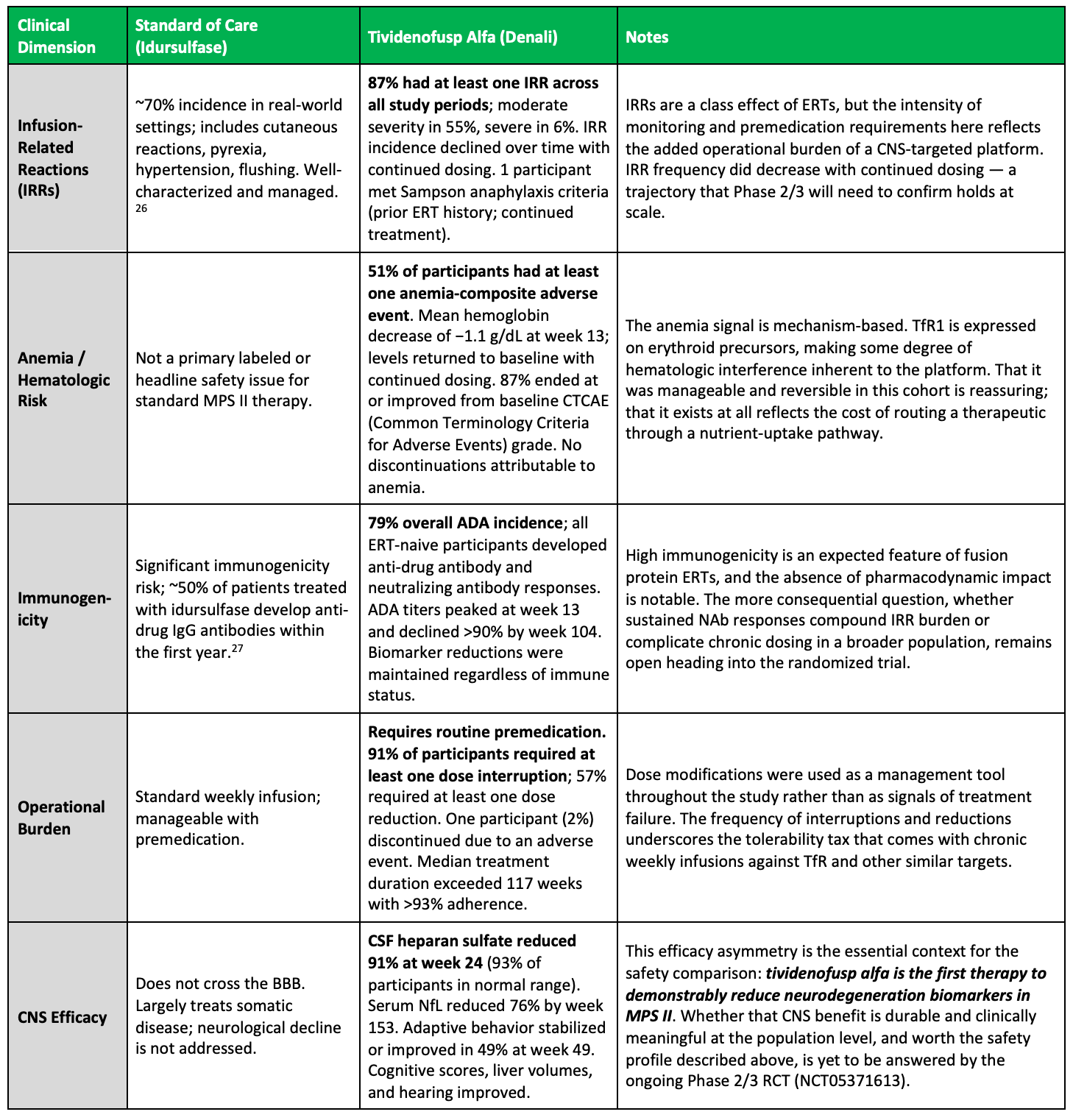
A stark example of the delivery-efficacy tension lies in the Phase 1/2 clinical data for Denali's tividenofusp alfa in MPS II, published in January 2026.21 The study enrolled 47 male pediatric participants, with a median treatment duration of 117 weeks and adherence exceeding 93% across all study periods.
Table 4. A Comparison of Denali’s Tividenofusp Alfa and Takeda’s Idursulfase
As the data show, real breakthroughs in delivery efficiency do not automatically produce a medicine that outperforms the standard of care on every dimension. Tividenofusp alfa illustrates both sides of that tension at once. The platform achieves a 91% reduction in CSF heparan sulfate, with 93% of participants reaching the normal range for unaffected children, a feat idursulfase cannot replicate, since it does not cross the blood-brain barrier at all. However, it incurs physiological costs inseparable from the mechanism because delivery through TfR1 creates on-target liabilities.
● On-Target Hematologic Toxicity: TfR1 is the body's iron-import receptor, expressed at high levels on erythroid precursors. Engaging it to reach the brain therefore modulates on-target biology in the bone marrow, making some degree of hematologic interference intrinsic to the platform. Here it manifested as anemia-composite adverse events in 51% of participants, with mean hemoglobin reaching its nadir around week 13 before returning to baseline with continued dosing; no participant discontinued because of anemia. This is not an idiosyncrasy of Denali's molecule—the same on-target anemia signal has appeared with Roche's trontinemab—which is why it should be read as a mechanism-based caveat for the TfR shuttle class.
● High but Surmountable Immunogenicity: The study revealed a high immunogenic profile, with all ERT-naive participants developing anti-drug and neutralizing antibodies. Whether this immunogenicity is a consequence of TfR engagement specifically remains unproven, and the underlying mechanism remains unclear. What matters clinically is that the response proved surmountable: ADA titers peaked at week 13 and declined more than 90% by week 104, CSF biomarker reduction was maintained regardless of antibody status, and participants were able to dose through the ADA response without losing benefit. The residual burden is on tolerability: 87% of participants experienced at least one IRR, a management demand that, while declining over time, remains heavier than the idursulfase protocols refined over two decades of clinical use.
The longitudinal trajectory of both signals shows that the acute safety burden softens with chronic exposure; this has been borne out in the data. What it does not resolve is the more fundamental challenge. Investors and clinicians are looking for a next-generation target that achieves penetration without a mechanism-based safety profile that levies a tolerability tax on what the drug’s most compelling argument should be: the ability to treat a disease its predecessor could not reach.
Recent CNS innovation in delivery has shifted from chemistry to biology. The old constraint was physicochemical—the Goldilocks window of size, lipophilicity, and polarity that governs passive permeability. RMT does not so much win that argument as sidestep it: by exploiting the brain's own transport machinery, platforms like Denali's open the CNS to large-molecule modalities the MPO rules would exclude entirely. The 91% CSF substrate reduction is proof of concept that the delivery problem, in principle, can be solved. The next constraint lives in the biology of the receptor, asking how efficiently it transcytoses, how cleanly it releases, and what it costs on-target to engage it.
The field is also asking whether this delivery efficiency is commercially and clinically sustainable when the underlying pathway is saturable, peripherally expressed, and immunologically active. The next generation of BBB platforms will need to show not just that they can get in, but that getting in does not carry a cost the patient ultimately bears.
T.Rx’s Perspective
The industry may be approaching a structural ceiling with the first wave of nutrient transporter platforms. TfR and CD98 are biologically validated, but they are capacity-limited, heavily expressed on peripheral tissue, and immunologically active. Engineering more refined binders for these targets is an incremental improvement on a fundamentally constrained highway. As we evaluate this space, we are excited about companies operating with a higher degree of biological precision.
1. Flux Constraints
The primary limitation of TfR and CD98 is transport capacity. While viable TfR and CD98hc shuttles are engineered to bind outside the receptor site and do not compete with endogenous ligand, the receptors themselves are limited by their surface expression at the BBB and their intrinsic transcytosis rates. Once their capacity is engaged, higher doses add to peripheral exposure but do nothing to brain uptake. TfR compounds this with a large peripheral sink that clears shuttle before it reaches the brain and, at high affinity or avidity, drives mechanism-based reticulocyte depletion.
The next generation of BBB targets must offer either higher flux capacity or, more importantly, greater brain selectivity than today's nutrient transporters. The catch is that capacity and biology are hard to pull apart: TfR moves so much cargo precisely because iron transport is essential, so the same feature that lets it move so much cargo is what chains it to critical peripheral biology. Reaching for a higher-throughput nutrient receptor usually drags that problem along with it. The more tractable prize is a receptor expressed selectively on brain endothelium, decoupled from peripheral sinks, and from high-stakes systemic signaling like the insulin receptor's metabolic role. Even if its raw throughput is only comparable to TfR, a more selective receptor can enhance effective brain exposure with less lost to the periphery.
2. Target Specificity
Why do some emerging platforms report brain-uptake multiples of 20-30x standard shuttles? The gains come from treating delivery as a relay rather than a single gate. We have been most encouraged by approaches that pair a brain-selective delivery receptor with a second, neuron-facing address: either a single receptor expressed on both the brain microvasculature and the target neurons, or a bispecific pairing an endothelial delivery receptor with a neuron-subtype surface antigen. In both cases the unifying requirement is brain restriction: the target(s) are abundant across the brain's capillaries and on the intended neuronal population. The distal neuronal sink also sustains the concentration gradient and improves parenchymal retention (more of what crosses stays on target instead of washing back out) without exceeding the endothelium's intrinsic transport capacity.
3. Circuit-Selective Activity
Perhaps the most consequential frontier in CNS delivery is reaching the right neurons. Most neurological diseases are circuit-selective in their pathology: Huntington's targets corticostriatal medium spiny neurons, Parkinson's the nigrostriatal dopaminergic tract, Alzheimer's the cholinergic projections of the basal forebrain. Two mechanisms could make this biologically tractable.
In gene therapy, cell-type-specific cis-regulatory elements can confine expression to a target population regardless of where a vector distributes after crossing the BBB. A 2025 Neuron paper demonstrated this with an enhancer-AAV toolbox that distinguishes direct- from indirect-pathway medium spiny neurons, two anatomically interleaved populations that serve functionally opposed roles in the basal ganglia circuit.28 For non-viral modalities, bispecific architecture presents a parallel path: one arm drives BBB transcytosis, while a second arm binds a neuron-subtype-specific surface antigen. What excites us about this direction is that it reframes the delivery problem around circuit-level address. That is a far higher bar than brain penetrance alone, and we believe the platforms that can meet it will define the next generation of CNS therapeutics.
When evaluating the next wave of BBB biotech companies, we prioritize four technical pillars:
Endothelial Selectivity: Is the target restricted to the brain microvasculature and, ideally, the target neuronal population while remaining minimally expressed in peripheral tissues?
Binding Stoichiometry: Does the platform use affinity- and pH-tuned binding (e.g., weaker affinity, or pH-dependent release in the acidified endosome) to ensure fast dissociation and productive release once across the barrier?
Intracellular Target Engagement: Does the mechanism facilitate direct delivery into the neuronal cytoplasm or nucleus, rather than just reaching the CSF? CSF levels can be a poor proxy for actual brain parenchymal accumulation. To treat neurodegeneration, the drug must reach the disease-driving machinery inside the cell. With functional knockdown data in hand, we can prove the drug releases in a way prior attempts could not.
Feasibility of Scaling: Are platform outputs reproducible for large-scale manufacturing? Are there major CMC challenges that disrupt scalability? Complex delivery vehicles are only as good as their CMC profile.
Critically, an investable program must reinforce its claims with translational relevance using high-fidelity models. The leap from rodent brains to human architecture is all too often a primary point of clinical failure. To appropriately evaluate these technologies, we prefer to see data from models that recreate the neurovascular unit in a biomimetic human environment, and we are eager to move beyond standard laboratory animals to newer models that express human targets and share similar architecture with humans.
Conclusion: The End of the Beginning
History has taught us what does not work. The current generation of CNS leaders has proven that the delivery problem is solvable, but recent data make clear that solving it on one pathway does not mean solving it cleanly. Strong efficacy is remarkable, but all too often comes with a bill of safety and immunogenicity risk.
The next wave of BBB biotechs won't win by engineering better binders for the same pathways. They'll win by finding the private entrance: brain-selective portals, decoupled from the peripheral sinks that cap today's platforms, that deliver cargo directly to the disease-driving machinery inside the neuron, without the systemic tax current approaches can't escape.
References:
1. Gores, M. & Lutzmayer, S. Two Steps Forward, One Step Back: The Long Road to Success in CNS. IQVIA https://www.iqvia.com/library/white-papers/two-steps-forward-one-step-back-the-long-road-to-success-in-cns (2023).
2. Gores, M. & Lutzmayer, S. APAC perspective on Fostering Success in CNS Innovation. IQVIA https://www.iqvia.com/library/white-papers/apac-perspective-on-fostering-success-in-cns-innovation (2024).
3. Dotiwala, A.K., McCausland, C. & Samra, N. S. Anatomy, Head and Neck: Blood Brain Barrier. in StatPearls (StatPearls Publishing, Treasure Island (FL), 2026).
4. Alahmari, A. Blood-Brain Barrier Overview: Structural and Functional Correlation. Neural Plast.2021, 6564585 (2021).
5. De, R., Shi, S. & Kim, K. Crossing the Blood–Brain Barrier with Molecularly Imprinted Polymeric Nanocarriers: An Emerging Frontier in Brain Disease Therapy. Adv. Sci.13, e17004 (2025).
6. Mikitsh, J. L. & Chacko, A.-M. Pathways for Small Molecule Delivery to the Central Nervous System Across the Blood-Brain Barrier. Perspect. Med. Chem.6, 11–24 (2014).
7. Kreisl, W. C. et al. Increased P-gp inhibition at the human blood brain barrier can be safely achieved by performing PET during peak plasma concentrations of tariquidar. J. Nucl. Med. Off. Publ. Soc. Nucl. Med.56, 82–87 (2015).
8. Wager, T. T., Hou, X., Verhoest, P. R. & Villalobos, A. Moving beyond Rules: The Development of a Central Nervous System Multiparameter Optimization (CNS MPO) Approach To Enable Alignment of Druglike Properties. ACS Chem. Neurosci. 1, 435–449 (2010).
9. Rankovic, Z. CNS Drug Design: Balancing Physicochemical Properties for Optimal Brain Exposure. J. Med. Chem. https://doi.org/10.1021/jm501535r (2015) doi:10.1021/jm501535r.
13. Niewoehner, J. et al. Increased brain penetration and potency of a therapeutic antibody using a monovalent molecular shuttle. Neuron81, 49–60 (2014).
14. Bien-Ly, N. et al. Transferrin receptor (TfR) trafficking determines brain uptake of TfR antibody affinity variants. J. Exp. Med.211, 233–244 (2014).
15. Zuchero, Y. J. Y. et al. Discovery of Novel Blood-Brain Barrier Targets to Enhance Brain Uptake of Therapeutic Antibodies. Neuron89, 70–82 (2016).
16. Chew, K. S. et al. CD98hc is a target for brain delivery of biotherapeutics. Nat. Commun.14, 5053 (2023).
17. Couch, J. A. et al. Addressing safety liabilities of TfR bispecific antibodies that cross the blood-brain barrier. Sci. Transl. Med.5, 183ra57, 1–12 (2013).
18. Boado, R. J., Hui, E. K.-W., Lu, J. Z., Zhou, Q.-H. & Pardridge, W. M. Selective Targeting of a TNFR Decoy Receptor Pharmaceutical to the Primate Brain as a Receptor-Specific IgG Fusion Protein. J. Biotechnol.146, 84–91 (2010).
19. Chatterjee, S., Kon, E., Sharma, P. & Peer, D. Endosomal escape: A bottleneck for LNP-mediated therapeutics. Proc. Natl. Acad. Sci.121, e2307800120 (2024).
20. Stanton, A. E. et al. Engineered 3D immuno-glial-neurovascular human miBrain model. Proc.Natl. Acad. Sci. U. S. A.122, e2511596122.
21. Muenzer, J. et al. An Intravenous Brain-Penetrant Enzyme Therapy for Mucopolysaccharidosis II. N. Engl. J. Med.394, 39–50 (2026).
22. Smith, J. et al. TRONTIER 1 and TRONTIER 2: Pivotal trials of trontinemab in early symptomatic Alzheimer’s disease. Alzheimers Dement.21, e104294 (2025).
24. Masson, G. AbbVie axes Alzheimer’s program amid ‘evolving landscape’. https://www.fiercebiotech.com/biotech/abbvie-axes-mid-stage-alzheimers-program-amid-evolving-landscape (2024).
25. Choi, E. S. & Shusta, E. V. Strategies to identify, engineer and validate antibodies targeting blood-brain barrier receptor-mediated transcytosis systems for CNS drug delivery. Expert Opin. Drug Deliv.20, 1789–1800 (2023).
26. Karimian, Z., Whitley, C. B., Rudser, K. D. & Utz, J. R. J. Delayed Infusion Reactions to Enzyme Replacement Therapies. JIMD Rep.34, 63–70 (2016).
27. Kim, C. et al. Comparative study of idursulfase beta and idursulfase in vitro and in vivo. J.Hum. Genet.62, 167–174 (2017).
28. Hunker, A. C. et al. Enhancer AAV toolbox for accessing and perturbing striatal cell types and circuits. Neuron113, 1507-1524.e17 (2025).
Tiny Molecules, Tinier Incentives: How the IRA Rewrote the Small-Molecule Economy
Even the strongest science does not guarantee an investable asset. Here, we discuss how to align early-stage discovery programs for small molecules with investor expectations in a complex biotech funding environment.
Announcement
September 19, 2025
T.Rx Capital Launches $77.5M Fund I to Invest in Bold Startups at the Intersection of Technology and Biology
New venture capital firm to create and invest in early-stage healthcare companies applying novel technologies to frontier biology and redefine patient care
Article
July 12, 2025
Radiopharmaceuticals: The Next Frontier in Precision Cancer Care
Radiopharmaceuticals are emerging as the future of cancer care, combining targeted precision with powerful radiation to deliver safer, more effective treatments.
Ready to Transform Healthcare?
Join us in building the future of medicine through innovative technology and biology convergence